The software you choose to manage your livestock operation affects more than how you store records. It determines whether you can catch health issues before they cost you money, whether you’ll meet compliance requirements without panic, and whether your staff will actually use the system you pay for.
This guide walks through the real factors that separate software that works from software that doesn’t—based on what operations actually need, not what vendors want to sell you.
Why Choosing the Right Livestock Management Software Matters More Than Ever
Feed costs have increased 23% since 2020. Labor shortages continue across rural operations. The USDA’s electronic identification mandate took effect in November 2024, requiring RFID tags for interstate cattle movement. Quality assurance audits that once applied only to large processors now reach commercial cow-calf operations.
Your software choice directly affects your operation’s margins. The difference between a system that tracks per-head feed costs versus one that doesn’t can mean the difference between knowing which pens are profitable and guessing. The difference between automated withdrawal period tracking and manual calculations is the difference between shipping cattle on time and holding them an extra week because you’re not certain.
This isn’t about digitizing for digitization’s sake. Paper records can’t generate the year-over-year comparisons that show whether your breeding program is actually improving weaning weights. Spreadsheets can’t alert you when a treatment protocol violates FDA withdrawal requirements. Basic tracking apps can’t integrate with your RFID readers, breed association data, or accounting software.
The right software becomes your operational memory, your compliance documentation, and your decision support system. The wrong software becomes an expensive subscription you stop using after three months.
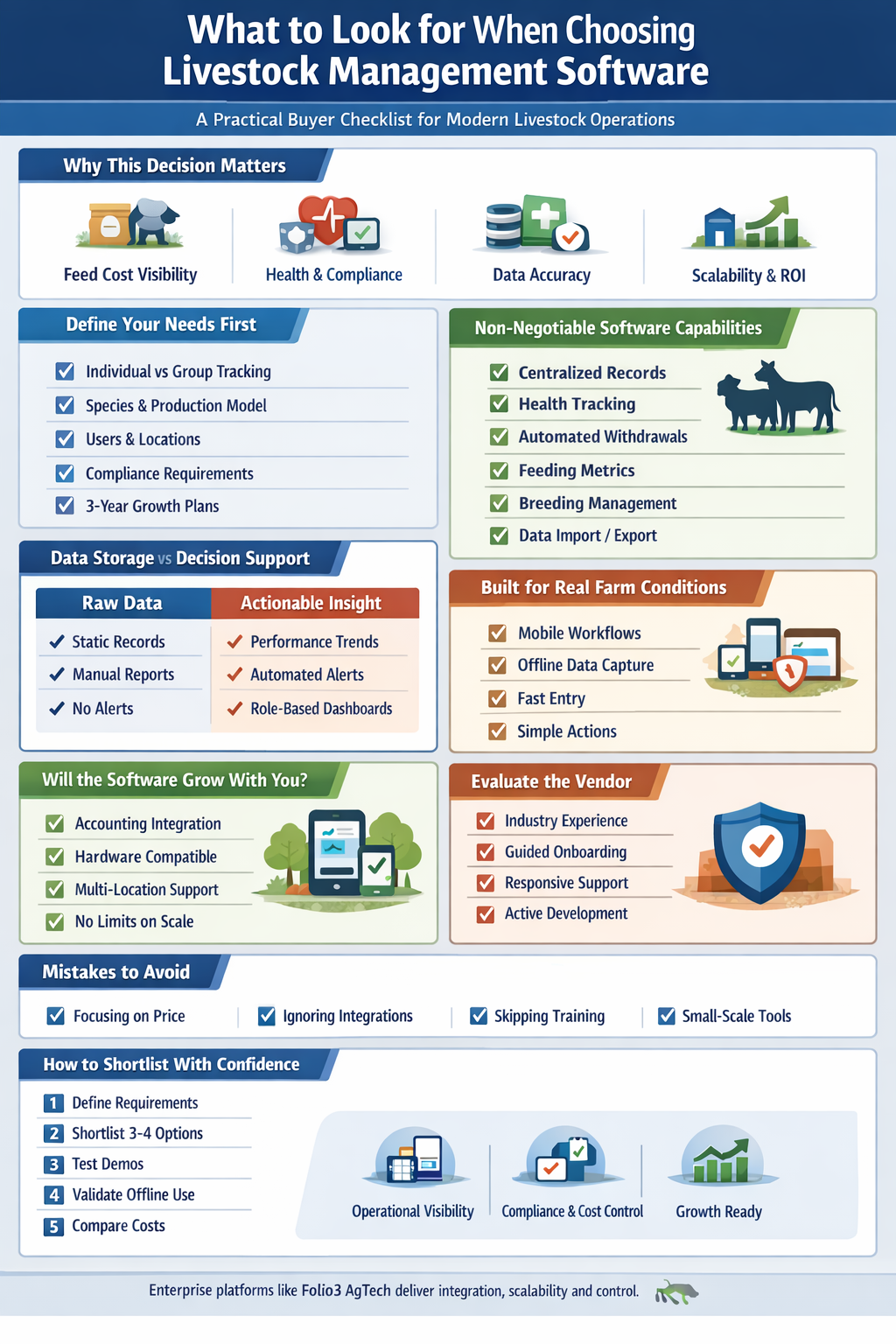
Define Your Operational Needs Before Comparing Software
Most operations start shopping by asking, “What’s the best livestock management software?” The better question is “what does my operation actually need to do?”
Individual Animal vs Pen-Level Management
Are you tracking individual animals with detailed health histories, breeding records, and performance data? Or are you managing groups by pen or pasture? Dairy operations and seedstock breeders need individual animal tracking. Commercial feedlots often work at the pen level. Some cow-calf operations need both—individual cows with detailed breeding records, but calves tracked by group until weaning.
This decision fundamentally shapes your software requirements. Individual tracking requires robust ID management, pedigree recording, and detailed event logging for each animal. Pen-level management needs strong group movement tracking, lot accounting, and aggregate performance reporting.
Species and Operation Type Complexity
A single-species beef cow-calf operation has different needs than a diversified farm running cattle, sheep, and goats. Dairy operations need milk production tracking and DHI integration. Feedlots need ration management and cost-per-gain analysis. Seedstock operations need breed association connectivity and EPD management.
Multi-species operations face an additional challenge: finding software that handles species-specific workflows without forcing you into separate platforms. Cattle need calving ease scores. Sheep need FAMACHA parasite monitoring. Goats need different breeding season tracking than cattle.
Number of Users and Locations
Who needs access to the data? Just you, or multiple family members, employees across shifts, and a consulting veterinarian? Are all users at one location, or do you need remote access from multiple pastures, a home office, and potentially off-site?
Single-user systems with simple password protection work fine for one-person operations. Multi-user operations need role-based access (so employees can enter data but can’t delete records or see financial information), activity logging, and conflict resolution when two people edit the same record simultaneously.
Regulatory and Reporting Needs
What external reporting do you face? USDA interstate movement documentation? Breed association data submission? Quality assurance program audits? Organic certification tracking? Export requirements?
Each adds specific data fields and report formats your software must support. If you sell registered breeding stock, breed association integration isn’t optional—it’s a core requirement. If you participate in age and source verification programs, precise date tracking and document generation become critical.
Future Growth Plans
Where will your operation be in three years? If you’re planning to double your herd size, expand to multiple locations, or add value-added marketing, can your software grow with you?
Entry-level software that caps at 500 animals forces you into a costly reimplementation when you hit 600. Systems without multi-user support don’t work when you hire your first full-time employee. Platforms without API access can’t integrate with the precision agriculture tools you might adopt next.
Planning for growth doesn’t mean buying enterprise software you don’t need today. It means understanding upgrade paths, data migration options, and the cost of switching systems versus staying with a scalable platform from the start.
Core Capabilities You Should Expect From Any Livestock Management Software
Regardless of your operation type, certain capabilities define whether software is actually functional or just a glorified spreadsheet.
Animal Records and Identification
Every animal needs a unique identity in the system. That identity should support multiple ID types—visual tags, RFID numbers, tattoos, brands, and breed association registration numbers—because real operations use combinations of these.
Centralized animal profiles should include biographical data (birth date, sex, breed, color), parentage (dam and sire linkage), current status and location, and complete event history. The system should handle multi-generation pedigree tracking (minimum three generations for serious breeding programs) and allow photo attachments.
Critical functionality: bulk import and export. You should be able to bring in existing records via CSV without manually retyping hundreds of animals. You should be able to export your complete data set at any time—your data shouldn’t be held hostage by a proprietary format.
RFID and EID Compatibility
With the USDA’s electronic identification mandate now in effect, RFID integration has moved from nice-to-have to essential for any operation moving cattle across state lines.
The technical standard is ISO 11784/11785—the global specification for 134.2 kHz livestock RFID tags. Your software must support both FDX-B and HDX tag protocols (the two technologies used in official 840 tags) and connect to readers via Bluetooth, USB, or WiFi depending on your hardware.
Look for software that pairs with major reader brands—Allflex, Tru-Test, Gallagher, Shearwell—without requiring proprietary hardware. The best systems support real-time Bluetooth scanning (scan at the chute and data populates immediately) plus offline data capture with later synchronization.
Lifecycle Event Tracking
Birth, weaning, movement, treatment, breeding, pregnancy check, calving—every significant event in an animal’s life should be timestamped and logged with relevant details.
But recording events isn’t enough. The software should use that data to calculate derived values: age in days, days on feed, days since last treatment, breeding status, expected calving date. These calculations turn raw records into actionable information.
Event tracking should also support workflows. When you record a treatment, the system should prompt for drug name, dosage, route, administrator, and lot number (all FDA-required data points) and automatically calculate meat and milk withdrawal dates based on the specific drug’s labeled withdrawal period.
Health, Treatments, and Compliance
Treatment records must meet FDA documentation requirements: the animal treated, drug name and lot/batch number, dosage and route of administration, treatment date, administrator name, and withdrawal time.
Automated withdrawal period calculation is the feature that separates agricultural software from generic databases. When you enter a cephapirin treatment, the system should know the meat withdrawal is 2 days and the milk withdrawal is 96 hours, then automatically flag that animal as ineligible for slaughter or milking until those periods expire.
Audit-ready records mean being able to generate a complete treatment history for any animal or group within seconds. When a buyer asks for verification that cattle have been off antibiotics for 60 days, or an auditor wants proof of your treatment protocols, you should be able to produce documentation immediately.
Feeding, Growth, and Performance Tracking
Feed represents your largest variable cost. Software should track feed intake at the individual or group level, tie consumption to specific rations and costs, and calculate feed conversion ratios.
Weight tracking over time—birth weight, weaning weight, yearling weight, finish weight—reveals which genetics are actually performing and which feeding programs deliver results. The system should calculate adjusted weights (205-day and 365-day adjustments are standard in beef production) and track average daily gain.
The real value comes from connecting feeding data to financial outcomes: cost per pound of gain, breakeven price, and profitability per animal or lot. Without these calculations, you’re tracking data but not making decisions from it.
Breeding and Reproduction Management
Breeding season management includes recording natural service and AI breeding events, tracking heat dates and synchronization protocols, logging pregnancy check results, and forecasting calving dates.
Detailed calving records capture birth date, birth weight, calving ease score (1-5 scale), and any assistance required. This historical data predicts which cow-bull combinations produce difficult calvings and which genetics produce easy-keeping cattle.
For serious breeding programs, genetic and lineage records become critical. The system should store EPD values (Expected Progeny Differences), calculate inbreeding coefficients when planning matings, and track which genetics appear in your most productive animals.
Reporting and Decision Support That Actually Helps You Act
Most software can store data. The differentiator is whether it turns that data into decisions.
The Difference Between Raw Data and Decision-Ready Insights
Raw data: “Pen 14 consumed 2,847 pounds of feed yesterday.” Decision-ready insight: “Pen 14’s feed conversion ratio has degraded 12% over the past week—check for health issues or environmental stressors.”
Raw data: “Cow 427 was treated with oxytetracycline on March 15.” Decision-ready insight: “Cow 427 reaches market weight next week but remains under withdrawal until March 29—hold or treat with a shorter withdrawal alternative.”
The software should actively surface problems and opportunities rather than requiring you to run reports and interpret trends manually. Early warning systems—animals losing weight, reproductive issues, health problems before they become obvious—distinguish platforms built for operational improvement from platforms built for record storage.
Role-Based Reporting Needs
Different people need different information. Ranch hands need daily task lists and animal location information. Operation managers need performance trends and exception reports. Financial decision-makers need cost analysis and profitability projections. Veterinarians need health histories and treatment protocols.
Software should deliver role-appropriate dashboards and reports automatically. Your morning report might show animals requiring attention today, while your month-end report aggregates financial performance across the operation.
Early Warning Signals
The most valuable reports are the ones you don’t have to remember to run. Automated alerts for animals approaching withdrawal clearance, breeding due dates, vaccination schedules, and performance anomalies turn software from a passive database into an active management partner.
Look for configurable alert thresholds. You should be able to set the system to notify you when any animal loses more than 5% bodyweight in a week, when feed conversion in any pen exceeds your target by 10%, or when any breeding-age female hasn’t been bred within your normal window.
Mobility and Ease of Use in Real Farm Conditions
Software that works beautifully in the office but fails in the field is worthless for livestock operations.
Mobile Access in the Field
Data entry happens at the chute during processing, in the pasture during breeding season, and at the feedbunk during daily checks. If your software requires returning to the office to log information, data either gets recorded on scraps of paper (then transcribed later with errors) or doesn’t get recorded at all.
True mobile capability means a full-featured app—not a simplified mobile view of a desktop application. You should be able to perform every critical workflow from your phone or tablet: add animals, record treatments, log weights, scan RFID tags, take photos, and run reports.
Offline Data Capture
Rural broadband gaps are real. According to USDA data, only 85% of farmers have internet access compared to the 95% national average. Even operations with connectivity lose signal in remote pastures, valleys, and processing facilities.
Offline capability is non-negotiable. The mobile app must fully function without internet, storing data locally and automatically synchronizing when connectivity returns. The synchronization must be intelligent—if two people edit different fields on the same animal while offline, the system should merge changes rather than forcing you to choose which version to keep.
Test this during demos. Literally disconnect WiFi on your device and try to enter a treatment record, scan an RFID tag, and record a weight. If the software breaks, it’s not ready for agriculture.
Speed and Simplicity of Data Entry
Processing day means working through dozens or hundreds of animals in hours. Data entry that requires five taps per animal breaks the workflow. Data entry that requires finding dropdown menus while wearing gloves is unusable.
The best systems optimize for speed: barcode scanning to populate animal IDs, reusable templates for common treatment protocols, voice input for notes, and batch operations to apply the same action to multiple animals simultaneously.
Complexity is the enemy of adoption. One CattleMax user summarized the industry sentiment: “If you’re not pretty computer savvy you won’t get along too well with it.” Software that requires extensive training or constant reference to help documentation won’t get used consistently, which means your data becomes incomplete and unreliable.
Integration Readiness and Long-Term Scalability
Your livestock management software doesn’t exist in isolation. It needs to connect to the other tools and systems you use—or will use.
ERP and Accounting Integrations
Financial management happens in QuickBooks, Xero, or Sage. Your livestock data includes revenue (sales), costs (feed, veterinary, supplies), and inventory (animal values). Manual reconciliation between livestock software and accounting software doubles your work and introduces errors.
Direct integration—where livestock software pushes transactions to your accounting platform automatically—eliminates duplicate entry. Look for platforms with native QuickBooks/Xero connectors or robust API access that enables custom integrations.
Feed Systems, Sensors, and Hardware Connectivity
If you’re using feed management systems, livestock scales, or IoT health monitoring devices, your software needs to ingest their data. Feed systems should push ration deliveries and consumption data. Scales should automatically populate weight records when an animal steps on. Smart collars and ear tags monitoring rumination, activity, and temperature should stream data into health profiles.
The connection methods vary—some hardware uses Bluetooth, some uses WiFi, some generates CSV files you import, and increasingly some uses API connections for real-time data flow. Your software should support the connection method your hardware uses.
Breed association integration is critical for seedstock operations. Can you export registration applications, import EPD updates, and submit show/sale records electronically? Platforms like CattleMax support direct data exchange with 20+ major cattle breed associations, eliminating manual data entry on association websites.
Risk of Outgrowing Basic Tools
Entry-level software often has hard limits: maximum number of animals, maximum number of users, limited reporting, no API access, and no advanced features like genomic data management or multi-location support.
These limits seem fine when you’re starting. They become dealbreakers when your operation grows. Reimplementing software—migrating years of historical data into a new system—is expensive, risky, and time-consuming.
Scalable platforms offer clear upgrade paths. You might start on a basic tier and move to an advanced tier as you grow, keeping all your data and simply unlocking additional features. Or the platform might be fundamentally elastic—supporting 500 animals or 5,000 without a migration.
Supply Chain Integration for Complex Operations
Operations that extend beyond the farm gate—managing feedlots, processing relationships, transportation logistics, or selling into quality assurance programs—need software that connects livestock data to the broader supply chain.
Platforms like Folio3 AgTech’s livestock management software are specifically designed for this level of integration. As a Microsoft Gold Partner with 20+ years in agricultural technology, they’ve built systems that connect livestock operations directly to enterprise resource planning (ERP) platforms like Microsoft Dynamics 365 and NetSuite. This means your animal performance data, inventory movements, and compliance records flow seamlessly into financial systems, supply chain management, and business intelligence dashboards.
For vertically integrated operations—those managing breeding, feeding, processing, and distribution—or operations selling into programs requiring traceability documentation, this supply chain connectivity eliminates the data silos that plague multi-system environments. You’re not exporting CSVs from livestock software and importing them into accounting software—the systems communicate directly, reducing errors and manual work.
This architecture also supports multi-location management, which becomes critical as operations grow or consolidate. Corporate oversight of multiple farm locations, centralized purchasing, consolidated reporting, and standardized protocols all require software that’s built for enterprise scale from the ground up rather than adapted from hobby-farm tools.
Evaluating Vendors Beyond Feature Lists
Features matter, but vendor maturity determines whether those features actually work in practice.
Industry Experience in Livestock Operations
Does the vendor understand livestock production, or are they a generic software company that added an “agriculture” product? Check whether the team has actual ranching or dairy experience. Do they attend industry conferences? Can their sales team discuss calving seasons and processing workflows intelligently, or do they just read from feature scripts?
Vendors with deep agriculture domain knowledge build software that fits real workflows. Generic providers build software that technically does what you asked but requires you to adapt your operation to their assumptions.
Implementation and Onboarding Approach
How does the vendor get you from purchase to productive use? Do they offer guided setup where someone helps you configure the system, import your existing data, and train your team? Or do they send you a login and a link to documentation?
Data migration is the hidden complexity in every software purchase. You have historical records in herd books, spreadsheets, or old software. Getting that data into the new system cleanly—with all the relationships between animals, events, and records intact—determines whether you can actually use the system for decision-making or you’re starting from zero.
Some vendors charge separately for implementation and training. Others include it in the subscription. Factor this into total cost comparisons—”free” implementation that takes you three weeks of frustration may cost more than paid implementation that takes one day with expert help.
Support Responsiveness
When something breaks during processing day, how fast can you get help? What are support hours—business hours in the vendor’s time zone, or hours that match when you actually work livestock?
Support quality varies dramatically. Phone support with staff who understand agriculture is the gold standard. Email-only support with 24-48 hour response times might work for office software but fails for operational tools. U.S.-based support teams generally understand American production practices better than overseas support centers.
Test support before purchase. Submit a pre-sales question through their support channel and measure response time and quality. This predicts what actual customer support will be like.
Product Roadmap Clarity
Where is the software heading? Is the vendor actively developing new capabilities, or has the product been feature-frozen for years?
Ask about upcoming releases. What features are planned for the next 6-12 months? Are they building IoT sensor integration? Expanding breed association connectivity? Adding advanced analytics?
Be cautious of vaporware—vendors who promise features “coming soon” to close sales but don’t deliver for years. Ask to see their release history. Regular updates indicate active development. If the last major release was three years ago, the platform may be in maintenance mode or approaching end-of-life.
Common Mistakes Buyers Make When Choosing Livestock Software
Understanding where others fail helps you avoid the same traps.
Choosing Based on Price Alone
The cheapest subscription usually costs the most in the long run. A $10/month platform that can’t integrate with your RFID reader forces you to manually type every tag number—adding hours of labor monthly. A $15/month platform that caps at 300 animals forces you to migrate systems when you hit 350 head.
Total cost of ownership includes subscription fees, implementation costs, hardware compatibility (do you need to buy specific readers?), staff training time, and the hidden cost of poor decision-making from inadequate reporting.
The comparison that matters: three-year total cost across vendors, including all the expenses beyond the monthly subscription. The mid-tier option with excellent support and smooth implementation often delivers better ROI than the budget option that nickels-and-dimes you with add-on fees.
Ignoring Integration Needs
Buying livestock software without checking whether it connects to your existing accounting software, RFID hardware, and breed association systems creates data silos—isolated collections of information that can’t talk to each other.
You end up manually transferring data between systems, doubling your work and introducing transcription errors. Or you abandon tools you’ve already invested in because they won’t work with your new software.
Map your integration requirements before shopping. What hardware do you already own? What financial software do you use? What external systems do you report to? Your livestock software must connect to these, or you need to budget for replacing them.
Overlooking Change Management and Training
Software fails when people don’t use it. The most common reason people don’t use software is because they don’t understand it or it disrupts familiar workflows too dramatically.
Include end users—the ranch hands who’ll actually enter data—in evaluation and training. If the least tech-comfortable person on your team can’t use the mobile app independently after one training session, adoption will fail.
Phased rollout reduces change management risk. Start by using the software just for animal identification and basic events. Once everyone is comfortable, add treatment tracking. Then add financial features. Gradual adoption builds confidence and catches workflow problems before they cascade.
Selecting Tools Built for Small Farms When Operating at Scale
Many livestock software platforms target hobby farms and small operations with a few dozen animals. Their architecture, pricing, and feature sets reflect those origins.
When a commercial operation with 500+ head tries to use hobby-farm software, they hit walls: performance problems (the app slows to a crawl with large datasets), missing features (no batch operations, no multi-user access, no advanced reporting), and arbitrary limits (maximum animals, maximum users, maximum report rows).
Match the software to your actual scale. A 50-head hobby farm can use simpler, cheaper tools. A 500-head commercial operation needs commercial-grade software. A 5,000-head feedlot needs enterprise platforms, even if the subscription costs more.
Underestimating Data Migration Complexity
Your historical data has value. Breeding records show which genetics perform. Treatment histories reveal recurring health issues. Financial records document profitability trends over years.
Getting this data from its current format into new software isn’t copy-paste. It requires mapping fields (your “tag number” becomes their “visual ID”), cleaning inconsistencies (dates in different formats, missing required fields), preserving relationships (calf-to-dam linkages, treatment-to-animal associations), and validating completeness.
Some vendors include data migration services. Most don’t, assuming you’ll handle it yourself. Budget time for this—typically 10-20 hours for a few hundred animals, much more for thousands of animals with extensive event histories. Or budget money to pay someone to do it right.
Not Testing Support Quality Before Purchase
You discover support quality when you need help, which is usually during a crisis—something broke during processing, you can’t generate a required report, data didn’t sync. By then it’s too late to choose a vendor with better support.
Test support during evaluation. Submit questions through all available channels (phone, email, chat) at different times of day. Measure response time, quality of answers, and whether you reach people who understand agriculture.
Ask current customers about their support experiences. What happens when you call on a Saturday during calving season? How long does a support ticket typically take to resolve?
How to Shortlist and Move Forward With Confidence
With dozens of platforms available, you need a systematic approach to narrow options and make a confident decision.
A Short Evaluation Checklist
Use these questions to shortlist candidates:
Requirements match: Does the software explicitly support your operation type (dairy, cow-calf, feedlot, sheep, multi-species)? Does it handle your scale (animal count, user count, location count)?
Critical features: Does it include offline mobile access, RFID integration, and FDA-compliant treatment tracking? These three are non-negotiable for most commercial operations.
Integration compatibility: Does it connect to your existing hardware (readers, scales) and software (accounting, breed associations)?
Vendor stability: Has the company been in business at least 3 years? Are they focused on agriculture, or is livestock software a side product?
Budget fit: Does the all-in cost (subscription plus implementation plus hardware if needed) fit your budget for the next three years?
Trial availability: Do they offer a meaningful trial period (minimum 14 days) with full feature access?
Platforms that pass all six criteria belong on your shortlist. Most operations should evaluate 3-4 finalists through detailed demos and trials.
What to Test During Demos
Prepare a demo script based on your actual workflows. For example:
- Record a new calf birth (dam ID, sire ID, birth weight, date)
- Enter a treatment with withdrawal period calculation
- Record a weight and calculate average daily gain
- Move a group of animals between pastures/pens
- Generate your most-used report (breeding report, inventory summary, financial analysis)
- Export data to verify you can get your records out
Ask the vendor to demonstrate using your specific scenario rather than their pre-built demo. Can they configure the software to match your operation’s workflow, or do they force you to adapt?
Test on devices you’ll actually use. If you work from a phone in the field, don’t accept a laptop demo. See the mobile app in action. If your tablet is three years old, test on hardware that old—not the vendor’s newest iPad.
Include at least one field-level employee in the demo. Can they navigate the interface? Would they use this during processing?
Metrics to Validate During Trials
A trial period lets you test under real conditions with real data. Measure these outcomes:
Setup speed: How long from signup to entering your first animals and recording your first events? Should be under 2 hours for basic setup.
Data migration success: Can you import historical records accurately? Check animal linkages, event histories, and calculated fields.
Daily workflow completion time: How long does it take to record common tasks compared to your current method? The new software should be faster or at least no slower.
Offline sync reliability: Turn off connectivity, enter 10 animals with events, reconnect. Does all data sync without errors?
Team adoption: After one training session, can your least-technical team member use the mobile app independently to record a treatment and scan an RFID tag?
Support responsiveness: Submit a support question. How fast do you get a helpful answer?
Report quality: Generate your most-used reports. Do they include the data you need in a usable format, or do you need extensive manual manipulation?
Integration testing: If you’re using RFID readers, scales, or breed association connections, test them during the trial. Do they work smoothly or require workarounds?
Performance under load: Enter 50+ animals with multiple events each. Does the app slow down or maintain responsiveness?
Data export: Export your complete dataset. Can you open it in a standard format and confirm all your data is there?
Platforms that pass your trial validation earn serious consideration. Platforms that fail critical tests should be eliminated—no matter how good the demo looked or how low the price.
Making the Final Decision
By this point, you likely have 1-2 finalists that meet your requirements, passed demos successfully, and performed well during trials.
The tiebreaker often comes down to fit—which platform feels most natural to your team’s workflow? Which vendor seems most responsive and trustworthy? Which platform’s roadmap aligns best with where your operation is heading?
Talk to current customers if possible. Vendors should provide references in your operation type and size. Ask those customers what surprised them (good and bad) after six months of use, what features they wish the software had, and whether they’d choose the same platform again.
Evaluating Enterprise-Grade Options for Growth-Oriented Operations
For operations that need centralized data management, scalability, and supply chain integration—particularly those planning to grow, add locations, or adopt precision agriculture technologies—enterprise-grade platforms deserve serious consideration.
Folio3 AgTech Livestock Management Software represents this category. With over 20 years serving the agricultural technology sector and managing 200,000+ animals annually across 500,000+ farmers, they’ve built systems specifically for operations that need more than basic record-keeping.
Key differentiators that matter for mid-to-large operations:
Supply chain connectivity: The platform integrates directly with ERP systems (Microsoft Dynamics 365, NetSuite) rather than operating as a standalone tool. For vertically integrated operations or those selling into quality assurance programs requiring full traceability, this eliminates the data fragmentation that occurs when livestock records, financial data, and supply chain information live in separate systems.
Multi-species and multi-site architecture: The software supports beef cattle, dairy, swine, poultry, goat, sheep, equine, and aquaculture operations—with species-specific workflows built in rather than bolted on. Multi-farm management capabilities with centralized oversight become critical as operations expand geographically or through acquisition.
AI-powered insights: Beyond basic record storage, the platform incorporates computer vision for livestock counting and weight estimation, predictive analytics for disease detection and feed efficiency, and behavior monitoring that flags health issues before they’re visible to human observers. This moves software from record-keeping to decision support.
Enterprise-grade technical foundation: As a Microsoft Gold Partner, the platform is built on proven enterprise architecture with proper security certifications, audit trails, role-based access controls, and the integration capabilities that connect to other business systems. This matters when you’re managing sensitive business data or need to meet corporate compliance requirements.
Proven implementation track record: The company’s case studies include large-scale feedlots, integrated livestock operations, and multi-location producers—meaning they’ve solved the data migration, change management, and system integration challenges that sink many software implementations.
This isn’t the right fit for every operation. Hobby farms, small cow-calf operations under 200 head, and operations with simple tracking needs will find more cost-effective options. But for operations planning significant growth, those already operating at commercial scale, or those needing integration across breeding, feeding, processing, and distribution, enterprise platforms like Folio3 AgTech’s solution provide capabilities that entry-level and mid-tier software can’t match.
Other Strong Contenders Across Operation Sizes
The market offers solid alternatives across different operation profiles. CattleMax serves the 500-5,000 head beef and dairy segment well with strong breed association integrations. Herdwatch excels for operations prioritizing mobile-first simplicity. AgriWebb targets grazing operations with strong pasture management features. Farmbrite offers good value for diversified farms running multiple species.
The right choice depends on your specific requirements, budget, growth trajectory, and technical environment. The systematic evaluation process outlined here—defining needs, assessing core capabilities, testing thoroughly, and validating with real workflows—gives you the confidence to select software that will serve your operation for years rather than months.
Your livestock management software should make your operation more profitable, more compliant, and easier to manage. If you approach the selection process strategically rather than impulsively, you’ll find the platform that delivers on that promise.