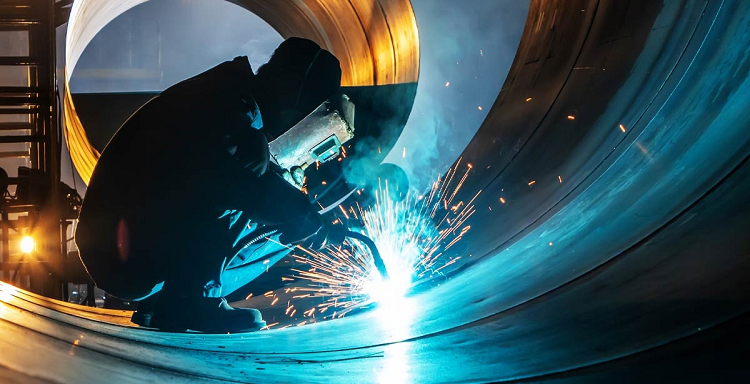
MIG stands for Metal Inert Gas welding or GMAW (Gas Metal Arc Welding) which is the most common method used in the industry. For many in the welding work sector, this is a standard way due to its efficiency, high viabilities as well as ease of use.
Note: UDO.CO.TH is a leading supplier of all types of welding wires. We maintain a ready-to-ship stock to meet the needs of businesses and industries. Additionally, if you have any questions about our welding products, our experienced specialists are available to offer advice and guidance.Visit us to learn more about welding wires at https://www.udo.co.th/category_product/กลุ่มลวดเชื่อม
Gas Metal Arc Welding (GMAW) also known as Mig welding, is a well-known form of joining metals together in small-scale manufacturing or automotive repairs and large industrial applications. Then what is it that makes this process so effective? The following are interesting to know more about the Gas Metal Arc Welding (GMAW/MIG) process and why it has become a dominant welding technique.
Basic of Gas Metal Arc Welding (GMAW/MIGü)
Gas Metal Arc Welding (GMAW/MIG) is essentially the process of creating an electric arc between a continuously fed wire electrode and the workpiece. Underneath itself, the arc produces enough heat of melting that melts the wire as well fuses it in with coat metal to facilitate a strengthened bond. Shielding gas is one of the key distinguishing features in this process, usually a non-reactive (argon) or mildly reactive gas mix such as argon with carbon dioxide that protects the weld pool from atmospheric contamination.
This gas is essential in shielding the welding region from oxidation and other types of impurities that might get sucked into a weld. In contrast to different welding kinds like Stick Welding or Flux-Cored Arc Welding (FCAW), GMAW / MIG requires a nonstop yield of protecting gas, causing the weld learn cleaner and permitting subsequently-to-none spatter(one thing according to any person attempt in imitation of performed above metal).
The first thing that makes gas metal arc welding as efficient of a process (particularly using GMAW/MIG) rather than trying to find literally any other way to work with some metals.
There are several reasons for the efficiency of Gas Metal Arc Welding (GMAW/MIG). Most importantly is that it has a direct feed of wire. Since the wire in GMAW/MIG is fed automatically, unlike manual welding processes that require regular stops and starts to reload electrodes. That permits faster and more uniform welding, which is an advantage especially in mass production.
In the case of Gas Metal Arc Welding (GMAW/MIG) welding can be made flat, vertical overhead and horizontal. This adaptability allows welders to apply the process across various project types, even those that require out-of-position welding.
### GMAW/MIG Efficiency Drivers
- *Automated Wire Feed System*: The automated continuous wire feed system in Gas Metal Arc Welding (GMAW/MIG) process ensures there is no down time, which makes this method extremely productive. Welders can reduce downtime from repetitive electrode changes keeping workflow on track and increasing overall productivity.
- **Low Slag Production:** The low slag production of GMAW/MIG means that no flux is involved in the process. This lowers the necessity for post-weld cleaning, increasing speed. Leaving you with a nice, smooth, clean weld that required no more than light gringing.
- **High Deposition Rates:** Gas Metal Arc Welding/MIG have high deposition rates. This enables welders to deposit more work, at a speedier rate which is good news for industrial applications where the clock is ticking.
- ** WELDER FATIGUE ** — While Gas Metal Arc Welding (GMAW/MIG) does require less manual manipulation including fewer electrode changes and slag removal, welder fatigue is greater due to the weight of GMAW wire feed systems. This helps in doing longer work with more productivity without compromising the quality,
- * Adaptability to multiple metals: One more thing which makes GMAW/MIG efficient is that it can work with diverse metal types. Capable of processing a wide range of materials, from carbon steel to aluminum and stainless steels; waterjet can be adjusted easily for many different cutting applications.
**The function of shielding gas for efficiency**:
The shielding gas in Gas Metal Arc Welding (GMAW) /MIG is an indispensable element that guarantees the raw quality of your weld. Argon and helium carbon-dioxide mixes are often utilized for their excellent arc stability along with good weld penetration. Not only that, but argon delivers a smooth, steady arc with very little spatter so there’s no waste and fewer stops.
Similarly, the gas helps keep the weld free from impurities that would otherwise enter it land there. If there is no shielding gas, substances like O2 and N will get into the weld pool thus cause defects i.e. porosity or cracking, etc Thus, the welding is of good quality and efficiency with the use of shielding gas.
The Science of Heat Transfer Efficiency
Heat Transfer — One of the reasons Gas Metal Arc Welding (GMAW/MIG) is so productive. This intense, focused heat source is the result of an electric arc formed between a wire electrode and workpiece. This decrease increases the localized heat and allows for quicker melting of metal to permit deeper penetration, which provides a higher quality weld. The heat is similarly concentrated at the end of the electrode, as well reduces energy that escapes into the atmosphere and delivers more directly to weld in GMAW/MIG.
The high power density in these heating systems means rapid delivery of heat, which enables the welding speeds to be many times faster than Stick Welding for example -where a far greater amount of energy is used on bulk materials. One of the key components to GMAW/MIG being one of the most efficient available welding processes is simply its ability to direct more energy where it belongs (into that darn weld) and less into space, on your tip, or in fancy tie-dye patterns through your butt joint.
When it Comes to Gas Metal Arc Welding (GMAW/MIG), The Applications within Different Industries:
Efficient: The efficiency of Gas Metal Arc Welding (GMAW/MIG) makes it a popular choice across several industries. It is very popular in the field of automotive where it is used to repair and produce vehicle parts for being precise as well as fast. Structural steel fabrication, one of the main sectors in industry that utilize GMAW/MIG welding, earmarks this process for critical weld joints due to high tensile strength.
For more massive industrial uses, equivalent to shipbuilding or pipeline construction, GMAW-MIG is most popular due its skill of prime-high quality welds at a sooner charge. It is also ideal for a variety of welding jobs due to the welder’s ability to work with both thin or thick materials.
### Conclusion
The efficiency of Gas Metal Arc Welding (GMAW/MIG) is down to its continuous wire feed system, minimal slag characteristics and typical deposition rates as well as heat input. It also uses shielding gas that results in high-quality and fast-welding processes, so it has become a popular welding method among industrialists. Doing everything from big, hefty construction projects to minor car repairs or precise art work and craft without a Gas Metal Arc Welding (GMAW/MIG) is like trying to open the door with a closed key.
Welding professionals can use that understanding of near-field welding to take better advantage of the tools and equipment made available in order to achieve high-quality welds without having to spend as much time on each job. The versatility and flexibility of Gas Metal Arc Welding (GMAW/MIG) will always make it a workhorse in welding for future millennia.