System on Module vs. System on Chip: What’s the Difference—and Why It Matters in Embedded Design

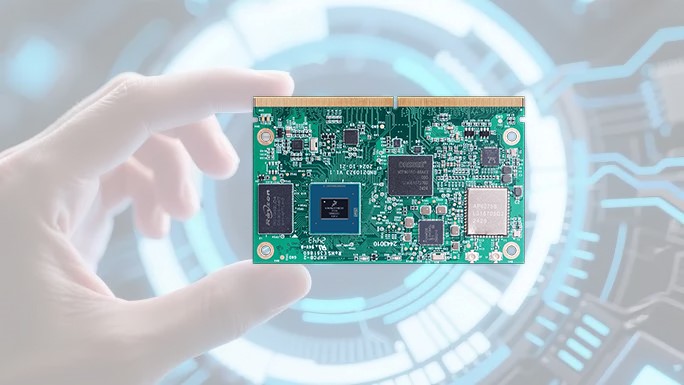
In the embedded computing world, two core technologies often lead to confusion: System on Chip (SoC) and System on Module. While they’re closely related, they serve different engineering needs—and choosing the right one can make or break a product’s scalability, performance, and time-to-market.
Whether you’re building AI edge gateways, smart devices, or industrial controllers, understanding how SoCs and SoMs differ helps you make smarter, faster hardware decisions.
What Is a System on Chip (SoC)?
A System on Chip integrates essential computing components into a single piece of silicon. These typically include:
- CPU for general processing
- GPU for graphics or compute acceleration
- Memory controllers
- I/O interfaces
- Optional AI accelerators like NPUs
SoCs are optimized for power efficiency and compactness, making them the go-to choice for consumer electronics, mobile devices, and edge platforms where every millimeter and milliwatt matters.
What Is a System on Module?
A System on Module is a compact computing board that combines a SoC with RAM, flash storage, power management, and I/O interfaces. Instead of designing a complete board around a bare SoC, developers can integrate a SoM into a carrier board, which includes the custom peripherals, connectors, and features specific to the end application.
This modular approach removes the complexity of low-level board design, lowers development risk, and shortens the product development cycle. Standardized formats—like OSM or SMARC—enable easy integration across different hardware platforms and product lines.
SoC vs. SoM: Key Differences at a Glance
| Feature | SoC (System on Chip) | SoM (System on Module) |
| Form Factor | Single chip | Compact module with SoC and essential components |
| Design Effort | High—requires full board design | Low—integrated computing module, carrier-board ready |
| Time-to-Market | Longer | Faster |
| Best Use Cases | High-volume consumer electronics | Industrial, AI, IoT, and long-lifecycle products |
| Flexibility | Fixed architecture | Modular, easier to upgrade or scale |
When Should You Choose a SoC?
A custom SoC-based design makes sense when:
- You’re building a high-volume product (e.g., smartphones, tablets)
- You need tight cost and layout control
- Your team has in-house hardware expertise
- Space and power consumption are extremely constrained
When Should You Choose a SoM?
SoMs are ideal when:
- You want to accelerate product development
- Your product requires hardware flexibility or future upgrades
- You’re targeting industrial, AI, or embedded edge use cases
- Your team wants to focus on software and application development rather than hardware design
Real-World Applications
| Use Case | SoC Fit | SoM Fit |
| Custom Android Device | Best for high-volume builds | Less ideal unless volumes are low |
| Smart City Edge Gateway | Complex to implement | Strong fit—modular and deployment-ready |
| Factory Automation Controller | Hard to scale and maintain | Excellent—supports long lifecycle and reuse |
Final Verdict: Which One Should You Choose?
Choose a SoC if you’re optimizing for cost, integration, and mass production.
Choose a SoM if you value design flexibility, time savings, and easier scalability.
In many B2B applications—especially across AI inference, industrial automation, and smart embedded devices—SoMs provide a reliable foundation. They allow you to leverage powerful SoCs like the RK3576 without investing time and resources into complex board design.
As embedded systems evolve, modular computing is becoming the preferred approach for building efficient, maintainable, and future-proof solutions.