
Pharmaceutical Cold Chain Logistics: A Practical Guide to Safe, Temperature-Controlled Transport


Pharmaceutical cold chain logistics coordinates the storage, handling, and transport of medicines within their labeled conditions, with controls and records at every handoff. Many vaccines use the familiar range of 2–8°C, but requirements vary by medicine. The product label, not a general rule of thumb, sets the target. The World Health Organization describes 2–8°C as the traditional vaccine cold chain, while allowing a different controlled temperature chain only for vaccines specifically qualified and labeled for it.
Keeping a shipment within range takes more than a refrigerated vehicle. Qualified packaging and storage, suitable transport refrigeration, calibrated monitoring equipment, trained handlers, and clear handoff records all play a part. In the United States, 21 CFR Part 211 calls for written warehousing procedures and appropriate storage conditions. The European Union’s Good Distribution Practice guideline calls for qualified equipment and, when temperature-controlled vehicles are used, maintained and calibrated monitoring equipment. These controls help teams plan for the full route, including transfers and last-mile delivery, and respond appropriately if readings fall outside the required range. A reefer unit supports temperature control in transit, but it does not replace qualified packaging, proper handling, or the shipper’s quality procedures.
Key Takeaways
- The product label, not a general rule, sets each medicine’s required temperature; 2–8°C is the traditional vaccine cold chain, while a controlled temperature chain applies only to vaccines specifically qualified and labeled for it.
- Each shipment needs a qualified plan for the full route, including suitable packaging, storage, transport refrigeration, carrier handoffs, and last-mile delivery.
- Calibrated shipment data loggers and traceable handoff records document conditions around the medicine; reefer telematics tracks refrigeration-unit operation but does not replace cargo monitoring.
- Before dispatch, teams should verify the reefer unit, setpoint, alarms, and monitoring equipment, then follow approved quality procedures to assess any temperature excursion before releasing the medicine.
What Is Pharmaceutical Cold Chain Logistics?
Pharmaceutical cold chain logistics coordinates the storage, handling, and transport of medicines within their product-specific labeled conditions, with records and controls at every handoff. The product label sets the required conditions. Although 2–8°C is familiar for many vaccines, it does not apply to every medicine. The goal is to preserve product integrity throughout the journey, because a temperature history outside specified conditions may require investigation before the medicine can be released for use.
The chain covers more than the time a vehicle is moving. It includes controlled storage before dispatch, loading, transport, transfers between carriers, and last-mile delivery to the receiving facility. Each transition needs clear responsibility, custody, and temperature records. Gaps in those records can make it harder to assess a shipment if a reading falls outside its permitted range.
Transport refrigeration, packaging, and storage each serve a distinct role. A reefer unit controls the environment inside a truck or trailer during transit, but it does not protect a shipment on its own. Qualified packaging helps protect the medicine according to its shipment requirements, while controlled storage and handling procedures support appropriate conditions before loading and after delivery. The shipper’s qualification and monitoring processes determine whether the selected combination suits the product and route.
A temperature failure can trigger a product investigation, delay delivery while teams assess the shipment, or result in product loss if the medicine cannot be used. Each outcome can add operating costs through extra handling, replacement product, or disruption to the delivery plan. The risk is not limited to a refrigeration breakdown. Storage, loading, carrier transfers, and the final handoff also affect whether the shipment stays within its labeled conditions.
Which Temperatures Do Medicines Require?
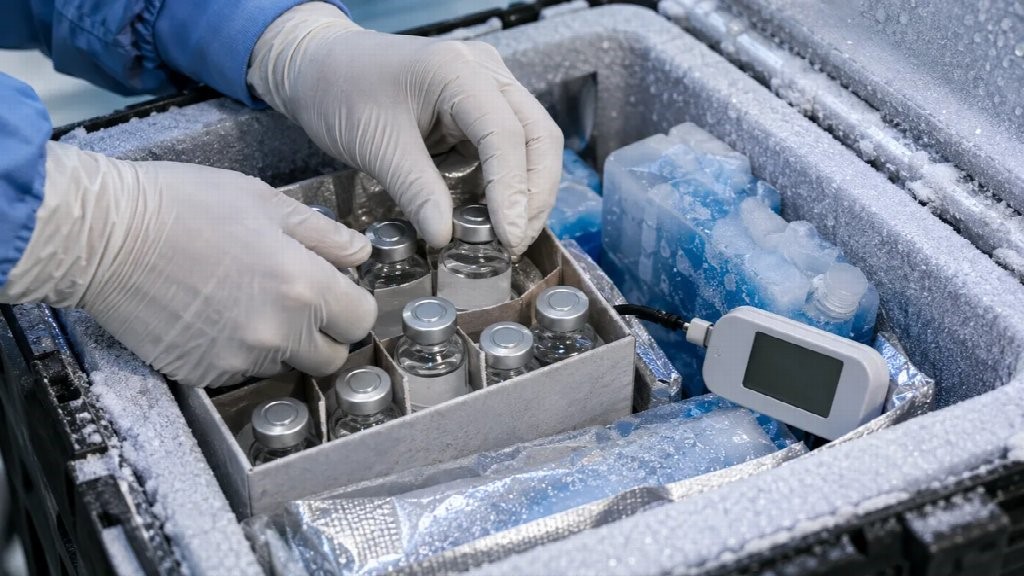
Medicines require the temperature conditions stated on their product labels. Those conditions may call for controlled room temperature, refrigeration, freezing, or deep-freeze storage. Refrigeration is not a universal requirement, and placing a medicine in a reefer does not make the conditions appropriate if its label specifies otherwise.
Recommended descriptive storage categories include 15–25°C for controlled room temperature, 5 ± 3°C for refrigerator storage, −20 ± 5°C for freezer storage, and −70 ± 10°C for deep-freezer storage. These categories help teams describe storage conditions, but the product label governs the required range for each medicine. For example, a shipment requiring deep-freeze storage needs a different temperature plan from one labeled for refrigerator storage.
The traditional vaccine cold chain is +2°C to +8°C. A controlled temperature chain is an exception for a vaccine specifically qualified and labeled for those conditions, not a general allowance to ship vaccines at warmer temperatures. WHO criteria require a qualifying vaccine to tolerate at least 40°C for a minimum of three days before administration. The vaccine must also be accompanied by a vaccine vial monitor and a peak-temperature threshold indicator.
Ultra-low-temperature vaccine shipments need equipment, packaging, and handling suited to the product’s labeled conditions. Teams should not assume that a standard refrigerated vehicle or routine cold-chain packaging can maintain an ultra-low temperature. The required set point and the suitability of the transport arrangement depend on the specific product label and shipment plan.
How Do Teams Qualify Each Shipment?
Teams qualify each pharmaceutical shipment by matching the product’s labeled conditions with a tested route, suitable packaging or transport refrigeration, capable carriers, and controlled storage at every handoff. The process should reflect the shipment’s actual risks rather than assume one arrangement suits every medicine or lane.
- Confirm the product requirements and shipment profile. Use the product label to identify the required temperature conditions, then assess the payload, route, transit duration, handoffs, likely ambient conditions, and access to backup arrangements. A short, direct road journey and a longer route involving air cargo and several transfers have different qualification needs.
- Choose packaging and transport equipment for the qualified lane. Qualified passive packaging can help maintain conditions without powered refrigeration, while active transport refrigeration may suit shipments that need temperature control during vehicle transit. The container or truck is not the refrigeration unit: a reefer unit controls the environment inside a refrigerated vehicle, while packaging protects the specific payload.
- Check storage and vehicle conditions under representative operating circumstances. Temperature mapping records conditions across a three-dimensional storage space and can help identify areas that may run warmer or colder. For temperature-controlled vehicles, the European Union Good Distribution Practice guideline calls for mapping under representative conditions that account for seasonal variation.
- Confirm warehousing procedures before dispatch and after receipt. In the United States, 21 CFR § 211.142 calls for written warehousing procedures, quarantine before quality-control release, and storage under appropriate temperature, humidity, and light conditions. Receiving and dispatch arrangements should fit the product’s labeled conditions and the shipment’s quality procedures.
- Verify monitoring equipment and carrier capability for the road leg. The EU Good Distribution Practice guideline calls for qualified equipment for temperature-sensitive products and regularly maintained, calibrated transport monitoring equipment when temperature-controlled vehicles are used. Carrier review should also cover the vehicle, its refrigeration unit, handling practices, and the records available at transfer points.
- Coordinate air cargo acceptance with the ground legs. IATA’s Time and Temperature Sensitive label and Standard Acceptance Checklist apply to healthcare cargo booked as time- and temperature-sensitive. Air transport also depends on controlled movement between storage facilities, aircraft, ground handlers, and delivery vehicles, so the plan should account for every handoff, not just flight time.
- Qualify the last-mile transfer and contingency arrangements. Confirm that the receiving location can accept the shipment under its required conditions and that the final vehicle or packaging suits the remaining route. Backup arrangements should address likely delays or equipment interruptions without assuming another carrier or storage site offers equivalent controls.
- Apply vaccine-specific guidance where relevant. WHO’s 2025 vaccine-shipping guidance adds direction for ultra-low-temperature vaccine shipments and notes that air freight remains the most widely used transport mode for vaccines. Teams should select handling and transport arrangements to meet the vaccine’s requirements, rather than treat all vaccine shipments as the same lane.
How Do Teams Monitor and Document Loads?

Teams monitor and document pharmaceutical loads with calibrated instruments and shipment-appropriate data loggers, supported by defined alarm responses and traceable records. The logger should capture conditions relevant to the product’s labeled requirements throughout the planned shipment, including storage and transport stages. Monitoring plans should specify who reviews the readings and how staff assess a potential excursion. Alert and escalation procedures should identify who receives each alarm, how quickly the shipment must be assessed, and who has authority to act. The plan should also identify a suitable location where the load can be moved if the current vehicle or facility cannot maintain the required conditions. Response steps should follow the shipment’s quality procedures and account for the product’s specific temperature limits. Reefer telematics can give fleet teams visibility into refrigeration-unit operation and support oversight across vehicles. Telematics data describes the unit and its operation, but it does not automatically replace calibrated cargo monitoring or shipment-specific records. A unit may be running while the shipment still needs to be assessed using its own monitoring data. Records should connect the medicine’s identity with its custody transfers, storage and transport conditions, and the people or organizations responsible at each handoff. If readings prompt an investigation, the file should also capture the assessment and any corrective action. A consistent record trail helps quality teams evaluate a shipment’s temperature history and determine what happened during a transfer or route interruption. Temperature mapping helps teams understand how conditions vary across storage areas and vehicle interiors under representative operating conditions. Mapping results should be reviewed when equipment, routes, or loading practices change, because a revised setup may affect where temperature-sensitive cargo can be placed. The World Health Organization’s temperature-mapping tool publication describes mapping temperatures in three-dimensional spaces; its Version 9.2 is compatible with six logger models. Monitoring should work as a coordinated system, not as a single display. For example, a reefer alarm can alert fleet staff to a unit issue, while a shipment logger records conditions around the cargo. Written procedures should explain how staff compare those records, document decisions, and preserve the shipment’s traceable history.
Where Do Pharmaceutical Cold Chains Fail?
Pharmaceutical cold chains often fail at handoffs and during last-mile delivery. Loading errors, route disruptions, power interruptions, and equipment problems can also put cargo conditions at risk. Delays at a transfer point can leave a shipment waiting outside its planned storage environment. During loading or delivery, open doors can expose cargo to conditions the transport plan was not designed to manage. Risk also rises when a route changes without an approved contingency or when carriers do not promptly communicate delays, vehicle changes, or equipment alarms. A missed update can leave the next handler unprepared to receive or protect the load. Clear responsibility for contacting logistics and quality teams matters at every transfer, especially when the delivery schedule or receiving arrangements change.
Equipment-related failures can begin before a vehicle leaves the facility. A refrigeration unit fault, interrupted power, incorrect setpoint, or inadequate pre-trip check can undermine the planned conditions. For example, a unit may be running at a setting that does not match the shipment plan, or a fault may go unnoticed until a driver or monitor reports a problem. Checks should confirm that the unit is operating as intended and that the planned temperature setting matches the shipment requirements.
When monitoring identifies a temperature excursion, the response should protect the load, notify the responsible quality and logistics contacts, preserve monitoring and custody records, and assess the product under approved procedures. Teams should document the assessment, decisions, and corrective actions, including any change to the shipment plan. A temperature reading alone does not determine whether a medicine remains usable. The responsible quality process must evaluate the product’s recorded conditions.
The costs of a cold-chain failure extend beyond packaging. An investigation can require staff time and additional handling, while a delayed shipment may disrupt receiving plans or require an alternate route. Product that cannot be released can create further loss. Costs vary with shipment size, route, duration, temperature range, packaging, and validation. A published general estimate for single-use passive packaging on 2–8°C lanes is 60 per shipment, not an all-in logistics rate.
Air cargo growth adds pressure to cold-storage capacity and transfer operations. A 2025 U.S. Government Accountability Office report found that pharmaceutical goods imported by air from Asia grew by more than 400% in volume between 2004 and 2023. Stakeholders also cited rising pharmaceutical and perishable imports as a source of greater cold-storage demand. As facilities handle more shipments, congestion can make coordinated handoffs and timely communication even more important.
Preventive Maintenance and Contingency Planning
A preventive maintenance plan should follow the reefer unit manufacturer’s schedule and reflect how the fleet operates. Frequent stops, long routes, heavy use, and demanding operating conditions can affect service needs, so maintenance teams should account for duty cycle and route demands when planning work. Record completed service and open defects so dispatchers can avoid assigning a vehicle with an unresolved refrigeration issue to a sensitive shipment.
Before loading, check the refrigeration unit’s condition and alarms, confirm fuel or power readiness, and verify that the setpoint matches the shipment plan. Inspect doors and seals for damage or anything that could prevent a secure closure, and confirm that monitoring equipment is ready to record conditions. Check the truck or trailer as well: tires, brakes, lights, and other roadworthiness items affect whether the vehicle is fit for the trip. A sound reefer unit cannot make an unfit vehicle suitable for pharmaceutical transport.
A contingency plan should identify whom to contact when an alarm, breakdown, or delay threatens the route. Include escalation contacts for dispatch, maintenance, logistics, and the responsible quality team, along with practical options for alternate transport or temperature-appropriate storage. Written criteria should state when staff may move a shipment, when they must hold it for assessment, and who can authorize each decision. Drivers and dispatchers should preserve shipment and equipment records during a disruption, while quality staff assess any impact on the product.
Train drivers, dock staff, and dispatchers on product handling, setpoint control, alarm response, and handoffs. Standard operating procedures should explain who checks the unit before loading, who receives an alert, how staff protect the shipment during a delay, and what information travels with the load at each transfer. For example, dock staff should know how to limit door-open time during loading, while drivers should know whom to contact rather than changing a setpoint without authorization. Practice the handoff between dispatch and the receiving site so a route change does not leave the next handler without instructions.
Equipment choice and service support should fit the shipment plan, including its required temperature conditions, route, and operating demands. Sonsray Fleet Services supports Thermo King transport refrigeration through sales, parts, service, installation, and warranty support. Factory-trained technicians and authorized Thermo King support may be relevant when a fleet needs reefer unit maintenance or repair. That support complements, but does not replace, the shipper’s quality system and shipment-specific procedures.
Build Visibility and Resilience Across the Fleet
A dependable pharmaceutical cold chain starts with qualified suppliers and carriers, not equipment specifications alone. Evaluate each partner’s ability to maintain the shipment’s required conditions and manage responsibility across the route.
- Confirm that the vehicle, reefer unit, storage, and backup equipment suit the shipment.
- Check staff training, monitoring practices, and how temperature records are reviewed.
- Verify handoff controls and documented escalation procedures for alarms, delays, and route changes.
The IATA CEIV Pharma process shows why capability includes people and facilities as well as equipment. Certification requires at least two staff members to pass its specified training course and includes a facility assessment lasting three to four days. A certificate can inform a review, but each shipper still needs to confirm that a carrier’s practices fit the specific product, route, and quality procedures.
Map performance by lane and handoff point. Compare route plans with actual transit patterns, transfer delays, reefer alarms, and temperature-excursion records to find recurring weak spots, such as a congested storage area or a leg with frequent schedule changes. Use the findings to revise handling instructions, carrier expectations, or contingency plans, then check whether the changes address the identified cause.
Standardize records across carriers and facilities so teams can connect shipment identity, custody changes, temperature data, equipment events, and escalation decisions. Consistent fields and timestamps make it easier to compare events across a route and determine where a response or handoff broke down. Review every excursion through the responsible quality process, document the assessment and corrective action, and look for patterns across shipments rather than treating each event in isolation.
IoT sensors can provide timely readings from cargo areas, vehicles, and storage locations. Predictive analytics can help flag patterns that may indicate a developing equipment fault or recurring process delay, giving maintenance and logistics teams an opportunity to investigate. An alert is a prompt for review, not a product-quality decision. Trained staff should verify the information and follow validated response procedures before changing a shipment plan or releasing product.
Prioritize improvements according to the threat to product integrity, the operational impact of downtime, and the cost of maintaining the required controls. A recurring reefer fault on a sensitive lane may warrant a different response from a documentation gap at a low-risk handoff. Qualified equipment, trained people, and documented procedures remain the foundation. Technology helps teams see where attention is needed.
Plan Your Next Temperature-Controlled Shipment
Before booking your next pharmaceutical load, prepare a lane brief for the shipment. Include the medicine’s labeled temperature range, payload, packaging plan, planned route, expected transit time, transfer points, and receiving location. Mark any leg that changes from air to road transport so each carrier can confirm its handling and acceptance requirements.
For an air leg, ask the carrier how the IATA Temperature Control Regulations (TCR) apply to the shipment and confirm its acceptance process before tendering the cargo. For a road leg, check that the reefer unit and vehicle arrangement suit the required conditions and route. Record any equipment issue that could affect dispatch rather than relying on the unit’s normal service history.
If the route depends on a Thermo King unit, contact Sonsray Fleet Services to ask about equipment fit, reefer unit service, parts, installation, or warranty support. Share the unit model, any active fault information, the planned operating conditions, and the route’s service needs when contacting the appropriate location. Ask which support is available for that equipment and location, and schedule maintenance before assigning the shipment if a known defect needs attention.
Keep the lane brief with the shipment records so dispatch, carriers, and the receiving team can work from the same instructions.
Frequently Asked Questions
1. Can a vaccine vial monitor replace shipment temperature records?
No. A vaccine vial monitor indicates a vaccine’s cumulative heat exposure, but it does not provide the shipment’s complete temperature history or document custody and handoffs. Keep the required shipment monitoring and distribution records even when a vial monitor is present.
2. What should a fleet verify after reefer unit repairs before carrying medicine?
Before dispatch, verify that the repair is documented, the reefer unit operates as intended, the setpoint matches the shipment plan, and alarms and monitoring equipment are ready. Check that a shipment-specific temperature logger is recording, since reefer telematics alone does not establish the conditions around the medicine.
3. How should alarm thresholds account for a product’s approved excursion allowance?
Set alarm thresholds through the responsible quality process using the product’s labeled conditions and any approved, product-specific excursion data. Configure alerts to give staff time to respond before conditions exceed the applicable limits. An alarm or excursion allowance does not by itself determine whether the medicine can be released.
4. When might air freight make more sense than road transport for a pharmaceutical shipment?
Air freight may make more sense when the route is long or the required delivery timing cannot be met reliably by road, provided the shipment can be protected through airport storage and ground transfers. Compare total transit time, handoffs, available temperature-controlled facilities, and contingency options. A direct road route may offer a simpler plan when it can meet the delivery requirement.


